
Apps for Learning Languages with Short Daily Practices

Learning a new language often fails less due to lack of motivation and more due to lack of routine. When studying depends on long blocks of time, the chance of interrupting everything increases, especially on days full of work, classes, commuting, and household chores.
That's why the theme apps for learning languages This appeals to those who need consistency without complicating their schedule. The central idea is not to spend hours a day in front of a screen, but to create frequent contact with the language in short, repeated, and realistic sessions. This aligns with principles of distributed practice, spaced repetition, and microlearning described in educational materials and studies on retention.
In practice, this changes the way you study. Instead of waiting for the "ideal moment," the reader starts using short intervals to review vocabulary, listen to audio, practice pronunciation, and revisit previous content. The expected result is not magic, but rather organization: less forgetfulness, less wasted time, and more clarity about what to do each day.
What does this topic mean in practice?
Studying with an app isn't just about opening a platform and tapping on random exercises. In practice, the app works best when it provides a simple path: listen, repeat, review, and return to the content at another time. This type of structure helps the brain recognize patterns and prevents studying from becoming too disorganized.
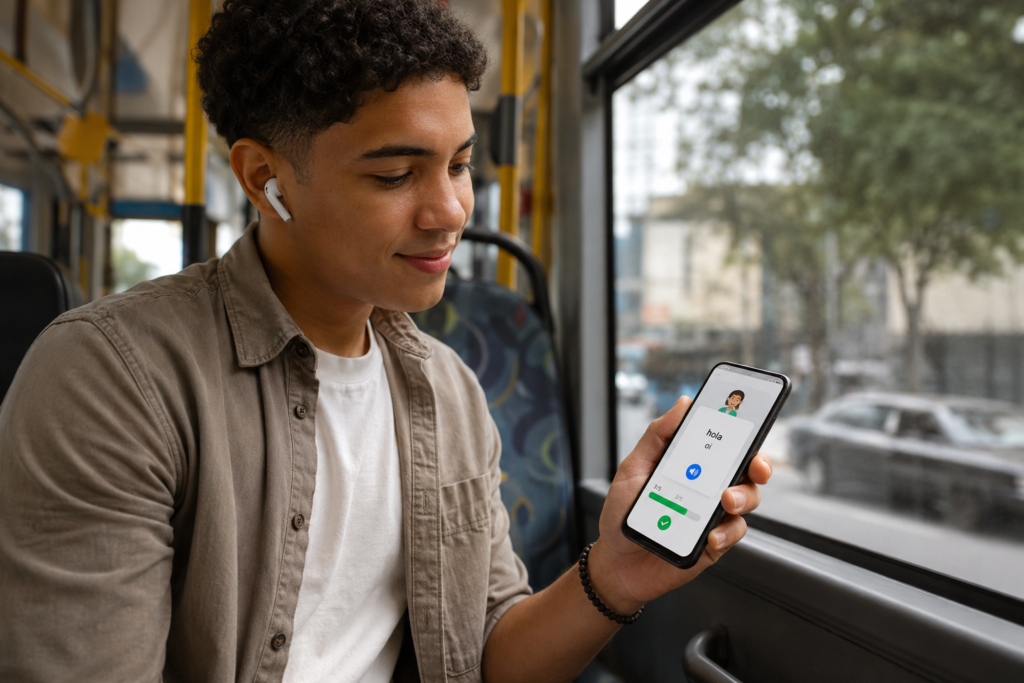
For beginners or intermediate learners, this makes a difference because learning often gets bogged down when there's too much information at once. Short training sessions reduce the initial friction. A five- to fifteen-minute block on the bus, during lunch, or before bed can be more productive than a long session done in a hurry and without review.
Apps for learning languages
Language learning apps often combine short lessons, guided listening, word review, and memory exercises. Some also offer voice recognition, flashcards, simulated dialogue, and progress tracking. The main point is not the quantity of features, but whether the tool helps maintain frequent contact with the language.
The reader benefits more when the app fits into the actual rhythm of the week. Those who work early may prefer quick workouts at the end of the day. Those studying for exams may need organized review by topic. And those who want to improve their communication skills may prioritize audio, oral repetition, and complete sentences, instead of just memorizing word lists. The choice changes according to the objective, available time, and current level.
How to choose a short routine that fits into the day.
A short routine needs to be simple enough to survive ordinary days. If it depends on total silence, two free hours, and perfect concentration, it will break down quickly. Therefore, the best starting point is to set a predictable and short time, such as always after coffee, on the way to work, or before bed.
It's also worth deciding on the type of training before you begin. One day could be dedicated to vocabulary; another to listening; another to pronunciation; another to reviewing what has already been covered. This alternation avoids monotony and respects the idea of studying in small blocks, with repetition over time, instead of trying to absorb everything at once.
What to consider before installing or paying.
Not every app caters to the same type of learning. Before installing, it's worth checking if there are clear explanations, natural audio, organization by levels, and a way to review what has already been learned. It also makes sense to check if the platform works well on the phone the person already uses, because a poor browsing experience hinders consistency.
Another important consideration is separating useful features from mere decoration. An app full of colors, badges, and notifications might seem appealing, but it doesn't replace well-structured content. The reader should ask themselves: does this app help me remember, speak, listen to, and easily retrieve the content, or does it just keep me clicking without clear progress? This question prevents wasted time and frustration.
How to study with 5-15 minute workouts
Short training sessions work best when they focus on one goal at a time. Instead of mixing everything at once, a person can do a round of vocabulary, then listen to short dialogues, and on another day practice short phrases aloud. This format combines well with microlearning, which organizes content into small, focused units.
In the Brazilian context, this applies to very common situations. A person might review phrases on the bus, listen to audio during their work break, or repeat expressions while waiting for an appointment. The benefit comes from spaced repetition: returning to the same content after a few hours or days is more helpful than tackling everything at once.
Common mistakes that hinder decision-making.
A common mistake is choosing an app simply because it seems "easy" or "fast." Initial ease can be deceiving if the content lacks review, listening, and practice. Another mistake is switching tools every week, which breaks continuity and prevents any real tracking of progress.
It is also detrimental to study using only passive recognition, such as touching on answers without attempting to speak, write, or recall the word from memory. Language learning progresses best when there is a balance between content input, production, and review. Studies and support materials in language learning reinforce this combination as the basis for a more consistent plan.
How to adapt the guidance to your context.
The best format varies depending on routine, age, goals, and internet access. Those who rely on mobile data can prioritize lightweight apps with offline mode. Those studying for travel might need practical expressions for airports, hotels, and transportation. Those looking to improve for work may need vocabulary specific to their field.
There is also a difference between learning independently and learning with external support. Those who already have some foundation can progress well with daily review and guided practice. Those starting from scratch may need clearer instructions, more examples, and fewer leaps in difficulty. Context matters more than the promise of "learning fast.".
When human help makes a difference.
Even with good digital resources, some aspects improve significantly with the support of a teacher, tutor, or more experienced colleague. Pronunciation, real listening, correction of recurring errors, and test preparation tend to become clearer when someone accompanies the process and corrects course.
This doesn't mean relying on formal classes for everything. It means recognizing your limits. If someone always gets stuck on the same type of exercise, can't understand their own mistakes, or needs a language for work, an interview, or an exam, human support can prevent months of inefficient study. In this case, the app helps, but it doesn't need to do everything alone.
Limits of what you can do alone
Studying alone works well for creating habits, expanding vocabulary, and becoming familiar with common phrases. However, when studying alone, the reader tends to be less aware of their own blind spots. This manifests in pronunciation errors, incorrectly repeated constructions, and difficulty conversing without mentally translating each word.
Therefore, the healthy limit is clear: the app can organize practice, but it doesn't replace all assessment. When the doubt is about performance for an exam, professional need, or persistent difficulty in understanding, it's worth seeking someone who can analyze the case more precisely. This decision avoids insisting on a method that has already shown little return.
Preventive and maintenance care
Maintaining study habits over the weeks requires less enthusiasm and more fine-tuning. A good practice is to review what you're still forgetting and reduce what has become too easy. This avoids the feeling of studying too much and retaining too little.
It's also helpful to track simple signs: if the app has become a distraction, if screen time has increased without learning, or if the routine has become too heavy, the plan needs to be simplified. Microlearning and distributed practice work best when the content remains small, frequent, and actionable, not when it tries to compete with the entire schedule.
How to compare options without falling for empty promises.
Comparing options responsibly requires attention to the type of progress each one actually offers. Instead of asking which is "the best," it makes more sense to ask which helps most with your current goal: reading better, listening better, speaking with more confidence, or reviewing from scratch. This shifts the focus away from marketing and towards real-world use.
Another useful criterion is to see if the app shows progress in a comprehensible way. A good system helps to see what has already been practiced, what needs to be revisited, and which content has been completed. Without this minimum of organization, the person may study, but they don't understand their own progress, which weakens continuity.
A practical rule for making a safe decision.
If the tool fits into your day, helps with reviewing, allows for short practice sessions, and doesn't complicate things more than it simplifies them, it already fulfills an important function. If, in addition, it matches your goal and your level, even better. The central criterion is not brilliance or quantity of features, but rather adherence to your routine.
A simple rule is this: start small, maintain it for a few weeks, and observe the real results. If there is more consistency, better vocabulary recall, and less feeling of abandonment, the structure is working. If there is only an accumulation of tasks and fatigue, the format needs to be reviewed before increasing the difficulty.
Practical checklist
- Define a specific goal, such as basic reading, everyday conversation, or travel review.
- Choose a short, fixed schedule that fits into your routine without requiring high motivation.
- Check if the content is organized by level and by useful topics.
- Test if the audio is clear and if the reading of the sentences is natural.
- Confirm whether there is a review of what has already been studied.
- Opt for short sessions with frequent revisiting of the same content.
- Avoid changing tools before measuring after two or three weeks of use.
- Check if the app encourages listening, speaking, reading, and reviewing, and not just tapping answers.
- Check if the app works properly on your phone and with your internet connection.
- Make a note of the topics you forget most easily and revisit those points first.
- Reduce notifications and distractions to maintain consistency.
- If you experience persistent difficulties, seek support from a teacher, tutor, or more experienced colleague.
Conclusion
Learning with digital help can be simple when the routine is realistic. The value lies less in the app itself and more in how it organizes small practice sessions, frequent reviews, and continuous contact with the language. When this happens, studying becomes easier to maintain and clearer to follow.
For those who are just starting out or already have some foundation, the safest approach is usually the same: start small, observe the results, and adjust without rushing. Have you tried maintaining a short study routine and noticed what hindered you the most? Is there any aspect of learning that still seems difficult to organize into your day?
The most important thing is to treat language learning as accumulated practice, not as a race. When the habit fits into real life, studying ceases to be a distant promise and becomes an achievable routine.
Frequently Asked Questions
Is it better to study every day for a short period of time, or only on days off?
In most cases, consistency helps more than infrequent and lengthy sessions. Frequent contact reduces forgetfulness and facilitates review of the content.
Is one app alone enough to learn a language?
It can be very helpful in routine and review, but it usually doesn't cover everything. Real speaking, varied listening, and error correction often require more than one form of practice.
How much time per day is usually considered reasonable?
It depends on the routine and the goal, but short blocks tend to be more sustainable. The best duration is the one a person can maintain for weeks without giving up.
How do I know if I'm making progress?
Notice if you remember more words, understand sentences with less effort, and can recognize structures that you previously missed. Language improvement usually happens gradually.
Is it better to focus on vocabulary or on conversation?
The two complement each other. Vocabulary without real-world use can become meaningless, and conversation without a basic foundation can lead to frustration.
Do I need to pay to study well?
Not necessarily. There are useful free options, but what matters most is the quality of the routine and the consistency of the content with your goal.
When is it worthwhile to seek support from a teacher?
When you experience persistent difficulty with pronunciation, comprehension, or organizing your studies. It's also worth seeking help if the language is necessary for exams, work, or other more demanding uses.
Useful references
British Council — spaced repetition in vocabulary study: British Council
UNC Learning Center — principles of language learning: UNC
EDUCAUSE Review — Microlearning and Retention: EDUCAUSE