Pregnancy test app: find out if you're pregnant

When menstruation is late, it's common to look for quick answers on your cell phone. pregnancy test app It can help organize dates, symptoms, and changes in the cycle, but it does not confirm a pregnancy on its own.
Doubt is often accompanied by anxiety, especially when there is nausea, cramping, breast tenderness, fatigue, or changes in menstrual flow. However, these signs can also appear due to stress, medication use, hormonal changes, weight fluctuations, breastfeeding, or naturally irregular cycles.
Therefore, the safest use of these apps is as a monitoring tool. They can indicate patterns, remind you of important dates, and help you understand when it makes sense to take a home pregnancy test, have a blood test, or seek professional guidance.
What can an app really do?
A women's health app works primarily with information provided by the user herself. It records menstruation dates, symptoms, sexual intercourse, contraceptive use, flow intensity, cramps, and changes noticed throughout the days.
With this data, the app can estimate the fertile period, the likely next menstruation, and a missed period. However, this estimate depends on the regularity of the cycle and the quality of the records kept by the person.
In practice, it functions like a smart agenda. Therefore, the more complete and consistent the history, the better the pattern recognition. Even so, the tool remains an estimate, not a diagnosis.
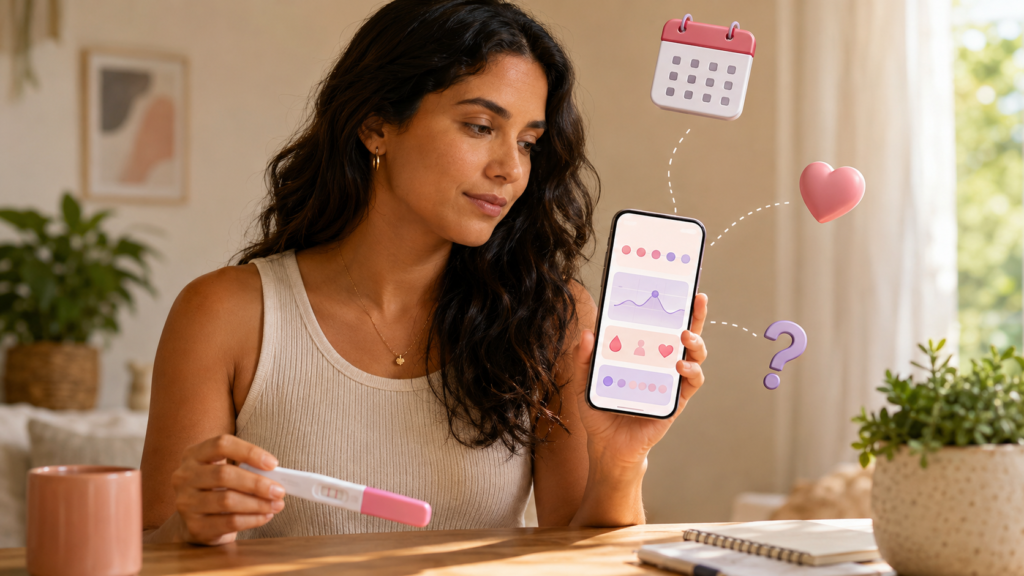
Pregnancy test app
The name may seem straightforward, but the actual function of this type of tool needs to be carefully understood. No app can detect pregnancy through the camera, fingerprint, screen, voice, or simply by answering questions on a cell phone.
What it can do is cross-reference information such as missed period, symptoms, date of last menstruation, and possible fertile period. From this, the app can suggest that the person consider taking a real test, especially when there is a missed period and a chance of pregnancy.
This detail is important because it prevents hasty decisions. A result calculated by an app should be seen as initial guidance, while confirmation depends on a urine test, blood test, or evaluation by a healthcare professional.
How do real tests confirm a pregnancy?
Pharmacy pregnancy tests and laboratory tests aim to identify the hCG hormone, produced after the start of pregnancy. Therefore, they analyze urine or blood, and not just symptoms perceived by the person.
When the test is done too early, a negative result may occur even in an early pregnancy. This happens because the hCG level may still be too low to be detected at that time.
A common guideline is to take the test starting on the first day of a missed period. When a person doesn't know when their period is due, a reference used by health services is to wait at least 21 days after unprotected sex before getting tested.
How to assess delay, cycle, and symptoms before taking action.
The first step is to look at the date of your last menstrual period. In regular cycles, a delay is more noticeable. However, in irregular cycles, interpretation requires more caution, because small variations can occur without indicating pregnancy.
It is also helpful to note if there was risky sexual intercourse, contraceptive failure, missed pills, condom breakage, or incorrect use of birth control. These factors significantly change how the delay is assessed.
Furthermore, isolated symptoms are not enough to draw any conclusions. Nausea, breast pain, sleepiness, mild cramps, and mood swings can all be caused by common hormonal factors, especially around the time of menstruation.
Safe step-by-step guide to using your cell phone as a support.
Start by recording the date of your last period and, if possible, your previous cycles. This history helps the app estimate whether the current delay is outside the usual pattern or within an expected range.
Next, write down symptoms with approximate dates. Instead of just noting "nausea," for example, record when it started, whether it was mild or intense, and whether it was accompanied by pain, fever, bleeding, or other discomfort.
Next, check if there were any risky situations. If there is a delayed period associated with unprotected sex or contraceptive failure, the most prudent course of action is to consider a real pregnancy test at the appropriate time.
Finally, use the app's results to organize the information, not as a final answer. If the pharmacy test is positive, inconclusive, or negative with a persistent delay, a professional evaluation can provide more reassurance.
Common mistakes that confuse the decision.
A common misconception is that all nausea means pregnancy. While nausea can occur in early pregnancy, it can also be caused by diet, anxiety, viruses, reflux, sleep disturbances, and other everyday factors.
Another mistake is taking the test too early and ending the investigation after a negative result. If menstruation does not occur and there is a real chance of pregnancy, it may be necessary to repeat the test after a few days or seek advice.
It is also risky to rely on home remedies, folk remedies, or tests without a reliable basis. Besides not confirming anything, they can delay an important decision, especially when there is severe pain, bleeding, or discomfort.
How to adapt the guidance to your context.
In Brazil, many people buy pregnancy tests directly from pharmacies, while others prefer to seek care at a health facility. The best choice may vary depending on access, income, privacy, local availability, and level of urgency.
Those with regular cycles can notice delays more easily. However, those with polycystic ovaries, who are breastfeeding, use hormonal contraceptives, have switched methods, or have long cycles may need to interpret the signs more carefully.
Teenagers, women trying to conceive, people undergoing fertility treatment, and those using IUDs or birth control pills should avoid jumping to conclusions. In these cases, individual history weighs heavily in the decision.
When the situation requires professional attention.
Some situations require immediate medical attention. Severe abdominal pain, heavy bleeding, fainting, significant dizziness, shoulder pain, fever, or severe malaise should not be treated solely with a phone search.
It's also worth seeking medical attention when the test is positive and there is pain or bleeding. In some situations, the professional may request a beta-hCG test, ultrasound, or other tests to safely assess the progression of the condition.
Even without signs of urgency, a consultation can be helpful when there is a persistent delay, very irregular cycles, medication use, a history of pregnancy loss, or doubts about contraception. Individual guidance avoids decisions based solely on assumptions.
Privacy and data security in the app
Cycle and women's health apps can store sensitive data. This includes menstruation, symptoms, sexual intercourse, fertility, contraceptive use, and possible pregnancy.
Before using a tool, it's worth checking what permissions it requests. An app of this type typically doesn't need access to contacts, microphone, precise location, or personal files to function properly.
It is also advisable to read the privacy policy, check if there is an option to delete data, and avoid registering very intimate information on unknown applications. When it comes to health, privacy is also part of the care.
Limits of what you can do alone
Cell phones can help organize information, but they don't replace tests, exams, or consultations. They can be useful for remembering dates, noticing patterns, and better preparing for conversations with a professional.
On the other hand, he is unable to assess clinical risks, interpret bleeding, confirm implantation, rule out ectopic pregnancy, or explain all the reasons for a delayed period. These points require proper evaluation.
A simple rule is to separate organization from confirmation. The app organizes data; the test verifies hCG; the professional interprets the context when there is doubt, risk, or a worrying symptom.
How to compare options without falling for empty promises.
When choosing an app, be wary of any tool that promises to detect pregnancy solely through questionnaires, screen taps, camera, or artificial intelligence without a real test. This type of promise can confuse those who are already anxious.
Choose options that clearly explain their limitations. A good app informs you that it works with estimates, allows you to easily track your cycle, and provides educational guidance without replacing a medical evaluation.
Another important point is simplicity. For many people, an app with too many features can be more of a hindrance than a help. Ideally, you should be able to record dates, symptoms, and observations without turning uncertainty into constant worry.
A practical rule for making a safe decision.
If there was a risky encounter and menstruation is delayed, the most responsible approach is to use the app only to check dates and track symptoms. Confirmation should come from a home pregnancy test, blood test, or a healthcare professional.
If the test is negative but the delay continues, it's worth repeating it after a few days or seeking advice. This is especially important when the cycle is usually regular and the delay deviates significantly from the usual pattern.
If there is severe pain, significant bleeding, fainting, intense dizziness, or a positive test with concerning symptoms, the app should no longer be the priority. In this situation, the person should seek professional help.
Practical checklist
- Record the exact date of your last menstrual period before interpreting any delay.
- Find out if your cycles tend to be regular, long, short, or unpredictable.
- Note if there was unprotected sex, condom failure, or forgetting to take birth control.
- Avoid concluding that you are pregnant solely based on nausea, sleepiness, cramps, or breast tenderness.
- Use the app to organize symptoms, not to confirm a diagnosis.
- Take a pharmacy test during the period indicated in the package insert or by your healthcare provider.
- Consider a blood test when the result is inconclusive or doubt persists.
- Repeat the test after a few days if there is a continued delay and a real chance of pregnancy.
- Seek medical attention if you experience severe pain, heavy bleeding, dizziness, or fainting.
- Check which permissions the app requests before creating an account.
- Avoid tools that promise to detect pregnancy using the camera, screen, or fingerprint.
- Keep important information to report during consultations, such as dates, symptoms, and tests performed.
- Talk to a healthcare professional if you use an IUD, hormonal contraceptives, or fertility treatment.
- Do not replace medical evaluation with automated responses when experiencing unusual symptoms.

Conclusion
Women's health apps can be useful when they help a person better understand their own cycle. They organize dates, record symptoms, and indicate patterns that might otherwise go unnoticed in daily life.
Even so, confirmation of pregnancy depends on an appropriate test and, in some situations, professional evaluation. The safest decision is to use technology as support, without turning an estimate into a diagnosis.
Have you ever used an app to track a missed period or symptoms? What was the biggest challenge in understanding the right time to take a pregnancy test?
Are there any specific questions about your cycle, pregnancy tests, or warning signs that still cause you insecurity in your daily life?
Frequently Asked Questions
Can an app confirm pregnancy?
No. An app can organize symptoms, dates, and cycle estimates, but it doesn't detect hCG. Confirmation depends on a urine test, blood test, or professional evaluation.
When does it make sense to take a home pregnancy test?
In general, the test is most useful after a missed period. If a person doesn't know when their period is due, it may be necessary to consider the time since the unprotected encounter and follow the instructions on the package insert or from a healthcare professional.
Does a negative result completely eliminate the possibility?
Not always. When the test is done too early, hCG levels may still be low. If the delay continues and there is a chance of pregnancy, repeating the test or seeking advice may be safer.
Do symptoms like nausea and sleepiness indicate pregnancy?
They can occur during pregnancy, but they also appear for various other reasons. Therefore, isolated symptoms should not be used as confirmation.
What is the difference between a pharmacy test and a beta-hCG test?
Pharmacy tests typically detect hCG in urine. Beta-hCG is a blood test that can help confirm hCG levels and, when requested by a healthcare professional, assess specific situations.
What should I do if the test is positive?
Ideally, you should seek medical advice to ensure you are receiving the appropriate treatment. This is even more important if you experience pain, bleeding, dizziness, or have a history of risk factors.
Is it safe to put intimate data on apps?
It depends on the app and its privacy settings. Before using it, check permissions, data policy, and the option to delete information.
When does doubt become urgency?
Severe abdominal pain, heavy bleeding, fainting, significant dizziness, or severe malaise require professional medical attention. In these cases, it is not safe to rely solely on apps or online searches.
Useful references
NHS — when to take a pregnancy test: NHS — pregnancy test
Mayo Clinic — How home tests work: Mayo Clinic — at-home tests
Febrasgo — rapid pregnancy test: Febrasgo — rapid test