Apps to Organize Tasks and Turn Your Cell Phone into a Smart Planner

In everyday life, many people don't need a complex system; they need a reliable place to remember appointments, prioritize tasks, and avoid rework. When this information is scattered across notebooks, messages, and loose notes, the chance of forgetting increases.
That's why task management apps have gained popularity as a practical tool for daily routines. They help bring deadlines, reminders, and tracking together in a single workflow, without requiring a complicated method right from the start.
The key point is not to accumulate resources, but to create a consistent way of seeing what needs to be done today, this week, and in the future. To do this, it's worth understanding how these applications work, what their limitations are, and what adjustments make a difference in real-world use.
What does it mean to organize tasks on your cell phone?
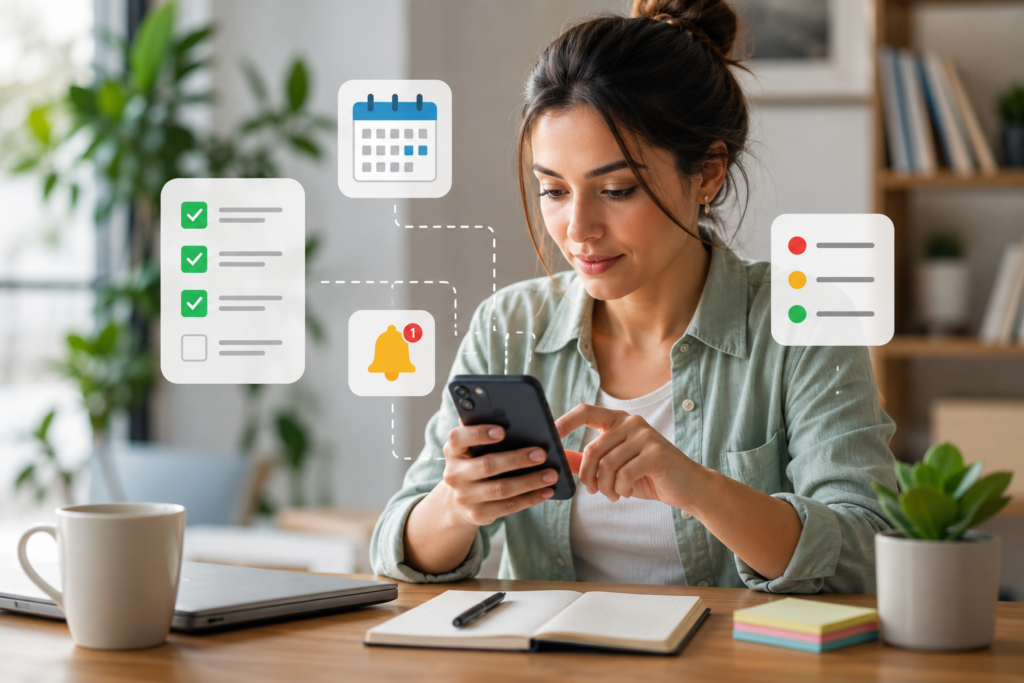
Organizing tasks on your phone means transforming the device into an action list, not just a notepad. The difference may seem small, but it significantly changes your routine because a task needs context, a date, priority, and follow-up.
A simple note holds loose ideas. A task, on the other hand, helps answer "what to do," "when to do it," and "what comes next." In practice, this reduces reliance on memory and makes planning more visible throughout the day.
It's also worth separating tasks from appointments on your calendar. Meetings, consultations, and classes fit better on the calendar; returning a book, paying a bill, or fulfilling a request are clearer as tasks.
This simple approach avoids confusion. When everything becomes a reminder, the phone starts sending too many notifications; when everything becomes a note, nothing is truly tracked.
apps for organizing tasks
These apps typically follow the same basic logic: create a task, set a deadline, activate a reminder, and in some cases, repeat it automatically. In official Google materials, for example, recurring tasks can be set up by day, week, month, or year; in Microsoft To Do, there are deadlines, reminders, and repetition; and in Apple's Reminders app, lists can be shared and tasks can be assigned to other people.
In practice, this means that the app's value lies not in decorating the interface, but in reducing friction. If creating a task takes too long, the person abandons its use; if the flow is simple, the habit is easier to maintain.
Therefore, a sensible choice usually prioritizes clarity over excessive features. A simpler app, but one that is reviewed daily, tends to work better than a system full of options that no one updates.
How to assemble a simple structure before you begin.
The first helpful step is to organize your mental screen before organizing the app. Instead of opening dozens of lists, start with a few categories: today, this week, and recurring. This already solves a good part of the initial mess.
The goal is to know where each type of action should go. Quick and urgent tasks go on today's list; pending items with less immediate deadlines go to next week; recurring commitments, such as material review, collections, or document sorting, go into a fixed area.
This model also helps to avoid duplication. When the same issue appears in multiple places, the feeling of control decreases because the person doesn't know which version is valid.
If your routine is more intense, it's worth creating separate lists for work, studies, or home. The important thing is not to turn the structure into a labyrinth. The fewer steps there are to understand the priority, the better.
How to turn your cell phone into a daily planner.
A cell phone becomes a planner when it's consulted at predictable times. Instead of only opening the app when something goes wrong, it's worth creating two review times: one at the beginning of the day and another at the end of the night.
In the morning review, the person checks what really needs to be done and adjusts what has been left behind. At night, they clean up what has been completed and reschedule what still depends on time, a response, or another person.
This habit works best when the app is easy to access. A shortcut on the home screen, a widget, or a fixed location in the device's navigation reduces the chance of forgetting about the system.
It also helps to record the action with a clear verb. “Resolve document,” “send file,” or “schedule appointment” provides better guidance than vague words like “subject” or “pending matter.”.
Common mistakes that hinder use
A common mistake is using the app as a repository for unfiltered ideas. The result is a long, jumbled, and tiresome list that looks more like a digital trash can than an organizational system.
Another problem is creating tasks without a deadline, context, or next action. When this happens, the person opens the list, reads the items, and still doesn't know what to do first.
It's also common to overdo it with notifications. The phone starts interrupting too much, and the user responds by turning everything off. After that, even the really important alerts cease to have any effect.
Duplicating tasks across multiple applications is another source of frustration. If one part is in notes, another in the calendar, and another in messages, trust in the system quickly diminishes.
How to adapt it to your context
The right way to organize tasks changes according to the routine. A student, for example, needs to keep track of assignments, exams, and pending readings; someone who is self-employed usually needs feedback, follow-ups, and deadlines.
A family might use their cell phone for shopping, home maintenance, school commitments, and dividing responsibilities. In such contexts, a shared list is often more useful than each person keeping their own version of the same task.
In Brazil, this happens in very common situations. It could be a reminder about a bill, renewing a document, scheduling an exam, or buying school supplies.
The important thing is that the method keeps up with reality, and not the other way around. The simpler it is to fit into daily life, the greater the chance that the system will remain viable.
When is it worthwhile to use shared lists?
Shared lists make sense when more than one person depends on the same information. This is the case for household shopping, chores, travel planning, group study, and small work teams.
On the iPhone, Apple allows you to share lists and assign reminders to others, which helps distribute responsibilities without relying on scattered messages. The feature is also useful when the group needs to keep track of what has already been done and what still needs to be done.
Even so, a shared list needs rules. It's necessary to define who updates it, when something is marked as completed, and which channel will be used for exceptions.
Without this agreement, the sharing becomes mere noise. The list continues to exist, but it ceases to represent the reality of the group.
What can you do alone and where are the limits?
A basic planning routine can be put together on your own: short lists, concise reminders, and daily review. This already solves a lot of problems when the difficulty is simply information overload and a lack of visual organization.
The limit is reached when the overload ceases to be occasional. If studies, work, or household responsibilities are frequently getting out of control, it may be helpful to talk to a trusted adult, a teacher, a coordinator, or another qualified professional for better guidance.
There are also limitations when the task involves technical, financial, legal, or health-related decisions. In these cases, the app only helps to track deadlines and documents; it does not replace expert guidance.
This distinction avoids practical errors. The cell phone organizes the schedule, but it cannot, on its own, resolve a situation that requires qualified human evaluation.
Preventive and maintenance care
A task management system only works well if it's reviewed. Without maintenance, the list grows, becomes outdated, and turns into a file of old pending tasks that no longer help anyone.
It's worth reviewing completed items, updating dates, and deleting anything that no longer makes sense. It's also a good idea to check if synchronization is active, especially when the device changes accounts, operating systems, or phone numbers.
Another precaution is to review notifications periodically. Sometimes the problem isn't with the app, but with outdated permissions, silent alerts, or settings that were changed without realizing it.
When routines change, the structure needs to change too. An organization that works well for a semester might not be suitable for vacation, and a structure designed for working from home might become too cumbersome during weeks of commuting.
How to compare options without falling for empty promises.
Comparing apps makes more sense when the criterion is real-world use. Instead of just looking at appearances, it's worth observing whether task creation is fast, if there are reliable reminders, if there's automatic repetition, and if synchronization works effortlessly.
Another important point is whether the app allows you to search for old tasks, separate lists, and keep track across different devices. For some people, the presence of sharing, subtasks, and widget support is also a factor.
A simple way to test it is to use the tool for a few days with real, routine tasks. If it hinders more than it helps, the problem may lie in the workflow, not the user.
It's also wise to be wary of solutions that require excessive configuration to deliver the basics. When everything needs to be customized before the first use, the chance of abandonment increases.
A practical rule to avoid losing control.
A helpful rule is this: if a task needs to be remembered, written down, and tracked, it deserves to be entered into the system. If it's still just a vague idea, perhaps it only needs to become a task after it becomes concrete action.
This prevents cluttering the app with items that have no owner, deadline, or next step. The more focused the record, the greater the chance it will actually help with the daily routine.
Another simple rule is to always review the system at the same time. Consistency is more important than perfection, because a small plan maintained for weeks is usually more efficient than an extensive organization that lasts two days.
Instead of trying to control everything, it's worthwhile to control what's within your reach. This approach makes your phone more useful and your routine less tiring.
Practical checklist
- Choose a single main app to focus on your daily tasks.
- Create short lists with clear titles, such as today, this week, and recurring.
- Write each item with an action verb and sufficient context for execution.
- Set a deadline only when there is a truly useful date or window of opportunity.
- Set reminders only for what you need to be alerted about, not for everything.
- Review the list at the beginning and end of the day for a few minutes.
- Delete or archive anything that is no longer relevant.
- Avoid duplicating the same pending item in notes, calendar, and messages.
- Test the synchronization by switching devices or accounts.
- Separate personal, school, and work tasks when there is excessive mixing of them.
- Use shared lists only when more than one person depends on the same information.
- Update recurring tasks whenever the routine pattern changes.
- Check that notifications are enabled and that the device is not silencing important alerts.
Conclusion
Organizing your routine on your phone doesn't depend on a perfect tool, but on a simple and stable method. When the app becomes a clear space to record actions, review deadlines, and track pending tasks, it reduces noise instead of increasing it.
The most important thing is to keep the system lightweight, consistent with the routine, and easy to review. If the structure is too cumbersome, it becomes just another source of work, not a support.
Have you ever gone through a phase where the mess of tasks seemed bigger than the time available? What part of organization usually gets in your way in your daily life?
Are there any specific questions about this topic that still make you hesitate when it comes to creating your own routine?
Frequently Asked Questions
What is the difference between a task and a reminder?
A task is an action that needs to be completed, while a reminder is the notification that helps to avoid forgetting that action. In practice, the two often work together. A good system usually uses reminders as support and not as a replacement for the task.
Do I need to pay to make good use of a task management app?
Not necessarily. Many apps offer enough features for personal routines at no cost, such as lists, deadlines, and basic alerts. What matters is ease of use, not price.
How many lists should I create?
Ideally, start with a few. Three lists are already sufficient for most routines: today's, weekly, and recurring. If there's a mix of contexts, such as studying and working, then it's worth separating them carefully.
Is it okay to use a calendar and a to-do list app at the same time?
Yes, as long as each has a different function. The calendar organizes schedules and appointments; the to-do list app tracks actions that need to be done. Mixing everything in the same place usually leads to confusion.
How can I avoid forgetting to open the app?
Leaving the icon on the home screen helps a lot. Creating a fixed time for review, like morning and evening, also works. When usage becomes a habit, the chance of abandoning it decreases.
Are shared lists suitable for both home and work?
They're useful, as long as there's a minimum set of rules for their use. At home, they help with shopping and household chores; at work, they help distribute small responsibilities. Without agreement, the list can become just a message board.
When is it best to ask someone for help?
When disorganization goes beyond simple forgetfulness and starts affecting studies, work, social life, or important decisions, talking to a trusted adult or a qualified professional can bring more clarity. The app helps, but it doesn't solve everything on its own.
Useful references
Google Tasks — recurring tasks and basic organization: support.google.com
Apple Reminders — shared lists and collaboration: support.apple.com
Microsoft To Do — deadlines, reminders, and repetition: support.microsoft.com